Christmas Lighting
Christmas Light Design Ideas for Knoxville Homes
New Age Lights • September 2026 • Knoxville, TN • 8 min read
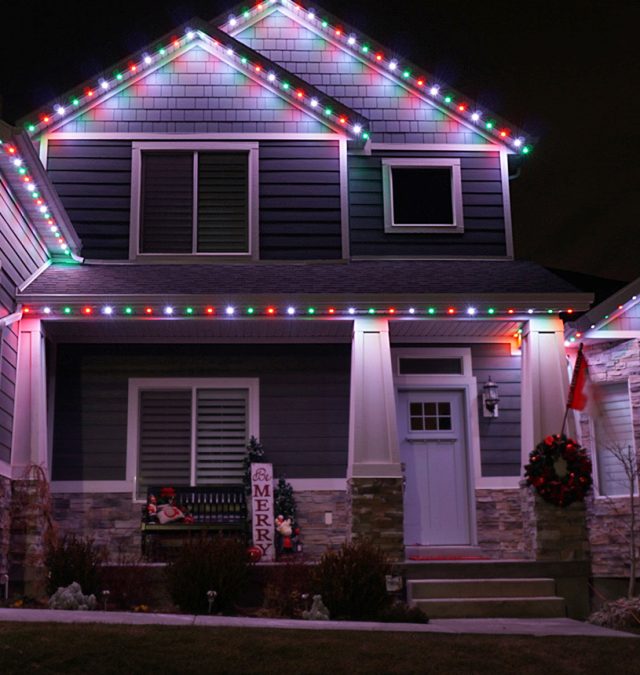
Start with the roofline, and decide what to leave dark
A good design is as much about what is not lit as what is. The roofline carries the display because it is the largest continuous line on the house and the one the street reads first. Everything else supports it.
- Front eave and gutter line. Always. This is the base line of the display.
- Street-facing gables. Outline the two sloping edges of each gable that faces the road. This is what gives a two-story house its silhouette after dark.
- Ridge lines. On a house with a visible main ridge or a hip roof, a ridge run ties the gables together. On a low ranch it often adds nothing and can be skipped.
- Side and rear elevations. Usually leave dark, unless a corner lot or a walkout faces a street. Lighting what nobody sees adds footage and cost without adding effect.
- Dormers. Outline them if there are one or two. With four or more, outlining every dormer gets busy; light the main eave and let the dormers sit in shadow.
The runs should turn where the roof turns and hold even spacing across the whole elevation. That is a product and installation question as much as a design one, which our Christmas light installation page explains.
C9 vs mini lights
These are two different tools, and most good displays use both.
| C9 bulbs | Mini lights | |
|---|---|---|
| Best use | Roofline, gables, ridge lines, columns, fence lines | Tree trunks and canopies, shrubs, garland, wreaths |
| How it reads from the street | Individual points of light that define an edge | A soft glow or dense sparkle, no defined line |
| Product | Large bulbs in heavy sockets on runs cut to length | Small bulbs on flexible strings |
| Durability in wet winters | Commercial-grade sockets hold up to freeze-thaw | Strings need replacing more often |
| Cost | Higher per foot | Lower per foot, more feet needed for coverage |
The common mistake is mini lights on the roofline. At roofline distance they blur into a faint line and the house loses its shape. Use C9s up top and save the minis for what they are built for.
Warm white, cool white or multicolor
| Color | Looks like | Works best on | Avoid on |
|---|---|---|---|
| Warm white | Soft, slightly golden, like incandescent | Brick, stone, wood siding, cream or tan trim, historic homes | Very cool gray exteriors, where it can look yellow |
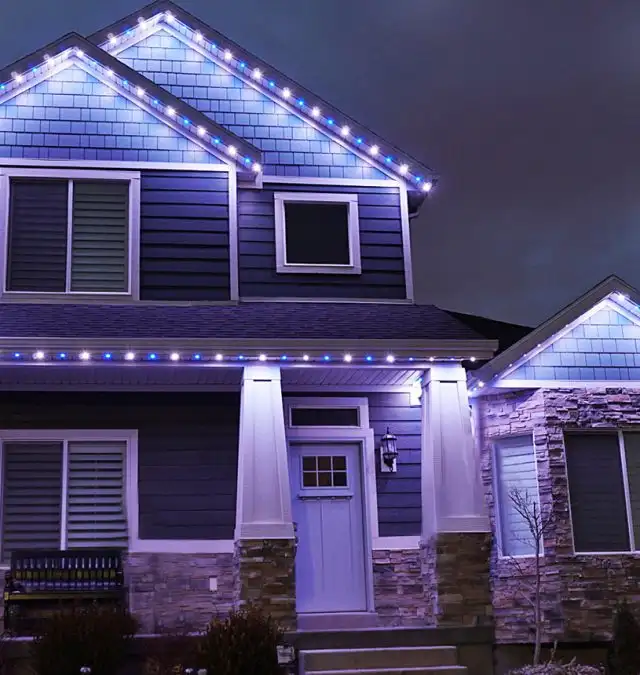
| Cool white | Crisp, blue-white | Gray, white or black modern exteriors, metal roofs | Red brick and warm wood, where it looks harsh |
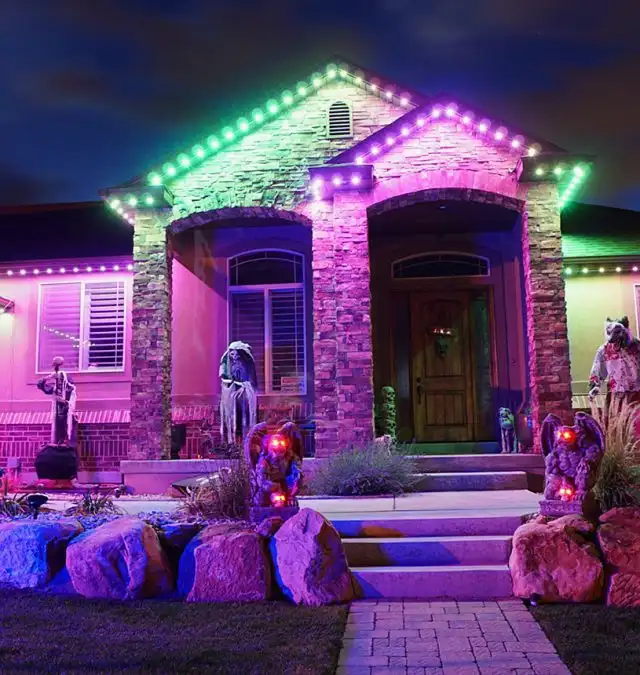
| Multicolor | Traditional red, green, blue, orange | Trees, shrubs, garland, a child's bedroom window | The roofline of a historic or HOA home, where it reads as busy |
| Red and white, or red and green | Classic two-tone | Roofline accents, candy-cane column wraps | Long unbroken eaves, where the pattern becomes a stripe |
The rule that saves most designs: pick one white and stick to it across the whole house. A warm white eave next to a cool white gable looks like a mistake rather than a choice. Most Knoxville exteriors are brick, stone or painted wood, which is why warm white is the default here.
The color-changing option
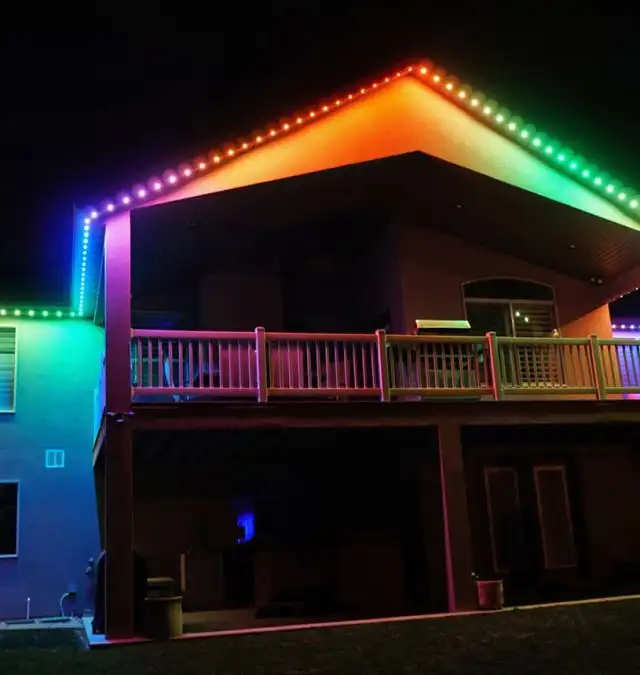
RGB C9 bulbs run any color from a remote or app. In practice most households run warm white through the week, red and green closer to Christmas, and Tennessee orange on a Saturday when the Vols are playing. The bulbs cost more than single-color C9s, and the design is otherwise the same.
The permanent version of the same idea is a track under the eave from JellyFish Lighting or Bosso Smart Lighting, with 16 million colors, saved scenes and schedules, that stays up all year and reads as trim in daylight. If you find yourself wanting color changes more than a couple of times a season, that is the point where a permanent system starts to make more sense than seasonal RGB, and our permanent vs seasonal comparison lays out the math.
Entry, columns, wreaths and trees
Once the roofline is set, the entry is where the eye lands. Keep it proportionate.
- Wreath. One, sized to the door or the gable above it, lit in the same white as the roofline. A lit wreath on a dark gable is one of the cleanest looks there is.
- Garland. Along a porch rail or over the door frame, with mini lights woven in. Garland on every horizontal surface becomes clutter.
- Columns. Wrap porch columns in C9 or mini lights in a spiral, or outline them straight. Spirals read as candy canes in red and white; straight outlines read as architecture in warm white.
- Tree wraps. Wrap the trunk and main limbs of one or two front trees in mini lights. A wrapped trunk with the canopy left dark is elegant; a fully wrapped canopy is a showpiece. Three or more wrapped trees start competing with the house.
- Shrubs and pathways. Net lights on foundation shrubs and stakes along the walk fill the base of the picture. These are the easiest parts to do yourself if you want a hybrid display.
Design by Knoxville house style
Knoxville is several housing stocks, and they do not want the same design.
Sequoyah Hills, Fountain City and the historic districts
Sequoyah Hills off Kingston Pike is a 1920s and 30s National Register historic district with notable mid-century houses mixed in, and Fountain City has its early-twentieth-century stock around the Gibbs Drive historic district. These homes reward restraint: warm white C9 along the main eave, the front gable outlined, a single wreath, and one wrapped tree. Mature trees across the sightlines mean the roofline is often glimpsed rather than seen whole, so clean lines matter more than coverage. Daytime appearance matters here too, so clips are matched to the edge and nothing shows when the lights are off.
Bearden and mid-century Oak Ridge
Bearden mixes older houses with modern infill along Kingston Pike, and Oak Ridge has original mid-century homes next to newer builds. Low, long rooflines suit a single continuous eave run in warm white with no ridge line, plus columns or a carport edge picked out. Skip the gable outlining if the pitch is shallow; it will not read from the street.
Farragut and Hardin Valley two-stories
Out west almost everything is under twenty years old, two stories and steeply pitched, with several street-facing gables. Here the gables are the design. Outline every peak that faces the road, run the eave line beneath them, and add the ridge if the roof has a strong one. Everett Woods in Hardin Valley has craftsman rooflines that look excellent with the eave and gable brackets picked out; Hanley Hall's wider elevations on larger lots take a longer eave run and two wrapped trees comfortably. A wreath on the tallest gable gives the whole composition a center. Our Hardin Valley page covers what those elevations take to reach.
Maryville and Powell
The older streets near downtown Maryville suit traditional roofline runs, wreaths and wrapped columns, while the newer subdivisions toward Alcoa Highway follow the Farragut pattern. Powell has a wide spread of house ages on the same street, so the design follows the individual house rather than the neighborhood. Maryville also sees December visitor traffic heading toward the Smokies, which makes a finished frontage worth more there than on a street nobody drives down; details on our Maryville page.
HOA-friendly restraint
Farragut and Hardin Valley subdivisions often have architectural rules, and the historic districts have their own expectations. A design that gets a yes usually looks like this: warm white C9 on the roofline only, clips matched to the edge so nothing is visible in daylight, no inflatables, projectors or animated elements, and a timer that switches off at a sensible hour. Bring any written rules to the design consult and we plan to them rather than asking for an exception later. The permanent-lighting version of this question, which comes up more often because the track stays up all year, is in our post on permanent lighting and HOA rules in Knoxville.
Commercial storefront design
Storefronts work differently. The goal is to read as open and to hold your own against the unit either side of you, not to look like a house. At Turkey Creek in Farragut that means a clean C9 run along the parapet or canopy edge in the store's own white, entry columns outlined, and nothing that competes with the sign. Downtown, where Market Square and Gay Street already carry the city's own display through December, an unlit storefront in the middle of it reads as closed, and a modest warm white frontage is enough to fix that. Offices along the Kingston Pike corridor and Oak Ridge's Main Street usually want the entrance canopy and the building edge, installed early morning or midweek. Our commercial and HOA Christmas lighting post goes into scheduling and phasing, and the commercial lighting page covers the service.
Frequently asked questions
Should I use C9 or mini lights on my roofline?
C9 bulbs for the roofline, mini lights for trees and shrubs. C9s are large enough to read as individual points of light from the street and sit in heavy sockets on runs cut to the roofline. Mini lights disappear at roofline distance and are built for wrapping, not outlining.
Warm white or cool white Christmas lights?
Warm white on brick, stone, wood and most painted trim, which covers the majority of Knoxville homes. Cool white reads blue-white and suits gray, white or very modern exteriors. Do not mix the two on the same elevation; the warm section will look yellow and the cool section will look blue.
Is multicolor or white better for a house?
White is the safer choice for the roofline and the better choice in a historic district or an HOA neighborhood. Multicolor works well on trees and shrubs, where it reads as festive rather than busy. Many of the best Knoxville displays run warm white on the architecture and color at ground level.
What should I light on a two-story home?
The front eave, every gable that faces the street, and the ridge lines that connect them. Skip the rear and side elevations nobody sees. On a Farragut or Hardin Valley two-story with several peaks, outlining the gables is what gives the house its shape at night.
Can I have color-changing Christmas lights?
Yes. RGB C9 bulbs run warm white most nights and switch to red and green, Tennessee orange or any other color from a remote or app. They cost more than single-color bulbs. Permanent systems from JellyFish and Bosso do the same thing year-round from a track under the eave.
What design works in a Knoxville HOA or historic district?
Warm white C9 on the roofline, clips matched to the edge so nothing shows in daylight, no inflatables or projectors, and lights on a timer that switches off at a sensible hour. Bring any written rules to the design consult and the display is planned to them from the start.
See the design before anything is ordered
We walk the property, show you which lines to light and which to leave dark, and give you a fixed quote for exactly that. Recent work across the metro is in our gallery.
Get a free quote or call (865) 264-0180.