Christmas Lighting
How Much Does Christmas Light Installation Cost in Knoxville? (2026 Guide)
New Age Lights • September 2026 • Knoxville, TN • 9 min read
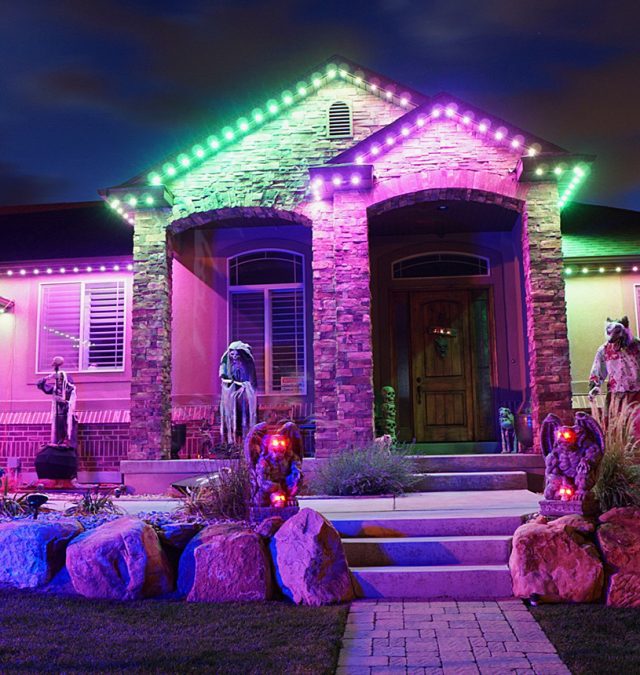
What Knoxville homeowners typically pay
Most installers, including New Age Lights, price seasonal lighting by the linear foot. That is the honest way to do it, because the roofline is what you are paying to light. A ranch in Powell and a two-story in Hardin Valley might have similar square footage inside and very different footage along the eave.
The ranges below are typical industry figures, not our price list. They are here so you can recognize a fair quote when you see one.
| Display scope | Typical range (industry) | What it usually covers |
|---|---|---|
| Roofline only, single-story front | $700–$1,200 | Front eave and gutter line, one color, timer |
| Roofline only, two-story front | $1,000–$1,500 | Front eave plus upper gables and peaks, lift access |
| Roofline plus entry accents | $1,500–$2,500 | Roofline, wreath, garland on the entry, wrapped columns |
| Full front display | $2,000–$5,000+ | Roofline, peaks, entry, two or three wrapped trees, shrub lighting |
| Full perimeter or large lot | $5,000+ | All visible elevations, long driveway trees, extended runs |
How installers price: what moves the per-foot number
When two quotes for the same house come back far apart, one of these is usually the reason.
- Linear footage. Eaves, gutter lines, ridge lines, gables and any columns or railings you want outlined. This is the product cost.
- Height and pitch. A one-story ranch is ladder work. A two-story front with a steep pitch is lift work, which takes longer per foot and needs equipment on site.
- Corners and peaks. Every gable and every turn is a place the run has to be cut, joined and secured. A simple rectangular roofline is faster than a modern elevation with five peaks.
- Product. Commercial-grade C9 LED bulbs on custom-cut runs cost more than retail mini-light strings and last many seasons longer. Color-changing RGB bulbs cost more again.
- Features beyond the roofline. Wreaths, garland, wrapped tree trunks, shrubs and pathway stakes are each priced separately and add up quickly.
- Access. Narrow side yards in newer subdivisions can stop a lift getting to the rear elevation, which changes the method and the labor.
How much to install 200 ft of Christmas lights?
Two hundred linear feet is close to what a typical two-story front with a couple of gables comes to once you add the gutter line and the peaks. Here is the math at typical industry rates.
| Scenario | Rate | 200 ft result |
|---|---|---|
| Low end, simple single-story eave, easy access | $2.50–$4 per ft | $500–$800 |
| Mid range, two-story front with gables | $4–$6 per ft | $800–$1,200 |
| High end, steep pitch, many peaks, lift required | $6–$8 per ft | $1,200–$1,600 |
So 200 feet of roofline usually costs somewhere between $500 and $1,600 for the season, and most turnkey programs land in the $700 to $1,500 band once design, service and takedown are in the price. If a quote for 200 feet comes back at $300, ask what the lights are and who comes out when a section dies in the second week of December. The answer is usually retail product and nobody.
The same 200 feet on a 1920s house in Sequoyah Hills, with mature trees across the front and a roofline that was never designed for a lighting run, takes more time to fit cleanly than 200 feet of straight builder-grade fascia in Hardin Valley. The footage is the same. The hours are not.
What is included in a turnkey program
A full-service seasonal program from New Age Lights includes all of the following, and a fair comparison quote should too.
- A free on-site design consult and a fixed quote before anything is ordered
- Commercial-grade LED product rated for outdoor winter use, not big-box retail strings
- Runs cut and fitted to your roofline on site rather than pulled off a shelf in set lengths
- Clips matched to your edge, whether shingle, gutter or fascia, with no nails or staples through roofing
- Installation, testing of every section, and a timer or app schedule set before the crew leaves
- In-season service: if a section goes dark, you call us and we come back out
- Takedown after the holidays
- Offsite storage of your lights until next season, with your measurements kept on file
When a quote is missing two or three of those lines, it is not cheaper. It is a different product. The full breakdown of how the service works is on our Christmas light installation page.
Lease vs buy, and why year two is cheaper
Most professional programs are a seasonal lease: you pay for the season, the installer owns and stores the lights, and failed sections are replaced at no charge. Some installers will also sell the product outright and charge labor only in later years.
| Lease program | Buy outright | |
|---|---|---|
| Year one cost | Lower | Higher, product is purchased |
| Renewal years | Lower than year one | Labor only, plus any repairs |
| Who owns the lights | Installer | You |
| Failed bulbs or runs | Replaced by installer | Your cost |
| Storage | Included, offsite | Your garage, or a storage fee |
| Changing the design | Easy, product is re-cut | You buy new product |
| Crossover point | Buying usually wins on paper by year two or three, if the lights survive that long and you accept the repair risk | |
Year two is cheaper on a lease for a plain reason. The design work is done, the runs are already cut to your house, and the crew has your measurements on file. The install goes up faster, so the labor drops. That is also why rebooking early matters: your set is already sized to your roofline and simply comes out of storage.
What Knoxville's housing does to the number
Knoxville is not one housing stock, and the quote reflects that.
Sequoyah Hills, Bearden and Fountain City
Sequoyah Hills off Kingston Pike was one of the city's first suburbs, developed in the 1920s and now a National Register historic district. Fountain City has its own early-twentieth-century stock around the Gibbs Drive historic district, and Bearden mixes that older housing with modern infill. These homes tend to be lower and more compact than the western subdivisions, which helps the footage. What adds time is the irregularity: fascia depth, drip edge and gutter profile change from house to house, sometimes along one street, and mature trees sit across the sightlines. Daytime appearance matters more here, so clip placement is more deliberate.
Farragut and Hardin Valley
Out west almost everything is under twenty years old, two stories and steeply pitched. Farragut subdivisions like Smith Farms, Rockwell Farms and Jefferson Park have long, unbroken rooflines that look excellent lit and are genuinely unpleasant to reach from a ladder. A two-story front with a walkout at the back can put the rear roofline three stories off the ground. Hardin Valley streets such as Everett Woods, Hanley Hall and Covered Bridge have straight builder-grade fascia that is quick to clip, but Hanley Hall's larger lots mean wider elevations and longer runs. Footage and height both push these homes toward the upper half of the range. Our Farragut and Hardin Valley pages go into the specifics.
Oak Ridge, Powell and Maryville
Oak Ridge has original mid-century homes and newer builds on the same streets, and two houses that look similar from the road can quote very differently because their linear footage is nowhere near the same. Powell has a wide spread of house ages along the I-75 corridor. Maryville sits closer to the mountains and takes more weather, so the fixings there are chosen for a wet January, not for speed in October.
How much should I pay someone to put up Christmas lights?
Enough that the lights are commercial grade, the installer is insured, and someone answers the phone in December. In practice that means the $2.50 to $8 per foot range above. Below that, you are usually paying a handyman to hang retail strings, and the savings disappear the first time a run fails and nobody comes back.
Can you pay someone to put Christmas lights up?
Yes, and there are two kinds of someone. One is a handyman who will hang lights you bought. The other is a dedicated installer who designs the display, supplies commercial-grade product, services it through the season and takes it down. The second costs more per foot and is the only one that still looks deliberate in January. Our guide to questions to ask before hiring a Christmas light installer in Knoxville covers how to tell them apart.
How do professionals install Christmas lights?
A professional crew measures the roofline first, then cuts commercial-grade C9 or mini-light runs to the exact length of each eave, gable and ridge. Bulbs are seated in sockets on the run, spaced evenly, and the run is fastened with clips matched to the edge, either shingle tab, gutter or fascia, never nailed or stapled. Power is planned from an exterior outlet with weather-rated connections, and a timer or app controls the schedule. Every section is tested before the crew leaves. On a two-story Farragut front that work happens from a lift, not an extension ladder.
When the fixed quote happens
New Age Lights does not quote from an aerial photo. We walk the property, measure the roofline and check the power, then show you the run and the number. Nothing gets ordered until you approve it, and the quote is the quote.
The consult is free and there is no obligation. The best time to book it is September or early October, before the calendar fills, which our post on when to book Christmas light installation in Knoxville explains in detail. And if you have started to wonder whether paying for a seasonal install every year still makes sense, our permanent vs seasonal comparison lays out the five-year math honestly, using JellyFish Lighting's published national guidance of $25 to $35 per linear foot as the baseline.
Frequently asked questions
How much should I pay someone to put up Christmas lights in Knoxville?
Typical turnkey programs in the industry run about $2.50 to $8 per linear foot. A roofline-only front on an average home usually lands between $700 and $1,500, and a full front with trees, wreaths and garland runs $2,000 to $5,000 or more. The price should include design, commercial-grade lights, installation, in-season service, takedown and storage. Anything quoted far below that range is usually retail strings and no service.
How much to install 200 ft of Christmas lights?
At typical industry rates of $2.50 to $8 per linear foot, 200 feet of roofline lighting works out to roughly $500 to $1,600 installed for the season, with most turnkey programs landing in the $700 to $1,500 band once design, service and takedown are included. Height, pitch, corners and how many peaks the run has to follow decide where in that range a specific house lands.
Why is the second year cheaper on a lease program?
Year one carries the design work, the custom-cut runs and the initial measurement. In year two the lights already exist, the measurements are on file, and the install goes up faster. Most lease programs price renewal years lower than the first year for that reason.
Is it cheaper to buy the lights or lease them?
Buying costs more up front and you own the product, but you also own the storage and any repairs. Leasing spreads the cost, includes service and storage, and the installer replaces failed sections at no charge. The crossover point where buying starts to win is usually year two or three, and only if the lights survive that long.
Does the quote change once the crew is on site?
It should not. New Age Lights measures the roofline at a free on-site consult and gives a fixed number before anything is ordered. If something on site would push the price up, you hear it at the consult, not on the invoice.
Do taller Knoxville homes cost more to light?
Yes. A two-story front in Farragut or Hardin Valley with a walkout at the back can put the rear roofline three stories up, which means a lift rather than a ladder and more labor per foot. Linear footage sets the product cost; access sets the labor.
Get a fixed number for your roofline
We measure the house in front of us, show you the run, and give you one price that includes design, commercial-grade lights, installation, in-season service, takedown and storage. Our office is in Oak Ridge and we cover the whole Knoxville metro from there.
Get a free quote or call (865) 264-0180.